Revision Module: 13 of 14
Full Free Driving Theory Practice Test 13
Your final comprehensive practice check covering all general UK road rules and traffic signs.
Syllabus Covered
The Highway Code & Traffic Signs
Question Pool
25 Multiple-Choice Questions
Target Pass Mark
Aim for 86% or higher
📝 Test Instructions: Your final review block. Aiming for an 86% or higher here shows you are completely ready for the actual exam.
Start Theory Test 13
Real Exam Mode: Q&A with Explanations
On a motorway, you should not overtake by:
Passing on the right.
Passing on the left.
Checking your mirrors.
Signalling first.
You should not overtake by passing on the left. On a motorway, you should normally overtake on the right, unless traffic is moving slowly in queues.
Why is the hard shoulder less safe than a service area?
It is close to fast-moving traffic.
It has a lower speed limit.
It is only for large vehicles.
It is always closed.
The hard shoulder is close to fast-moving traffic, making it more dangerous. If possible, use a service area instead of stopping on the hard shoulder.
This sign means:
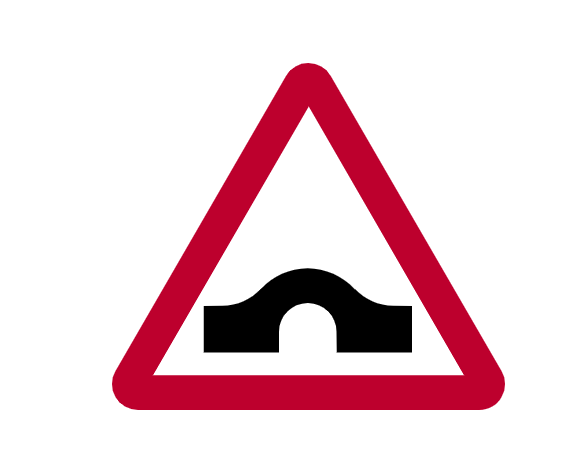
Swing bridge.
Tunnel ahead.
Hump bridge.
This sign warns that there is a hump bridge aheaSlow down, keep a safe speed, and be prepared for limited visibility over the top of the bridge.
This sign means:
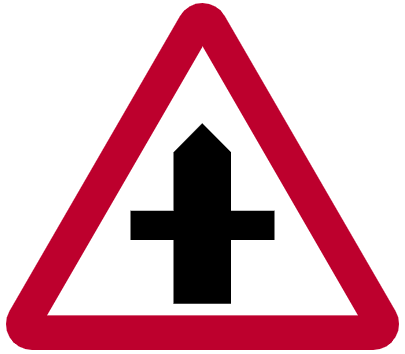
Pelican crossing.
T-junction.
Crossroads.
This sign warns that there is a crossroads aheaSlow down, watch for traffic from all directions, and be prepared to give way if necessary.
This sign means:
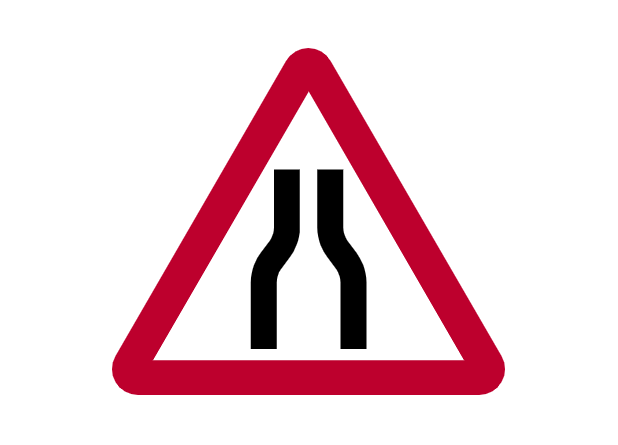
Dual carriageway.
Road widens ahead.
Road narrows on both sides.
This sign warns that the road becomes narrower on both sides. Slow down, stay in your lane, and watch for oncoming traffic or cyclists where space is limited.
This sign means:
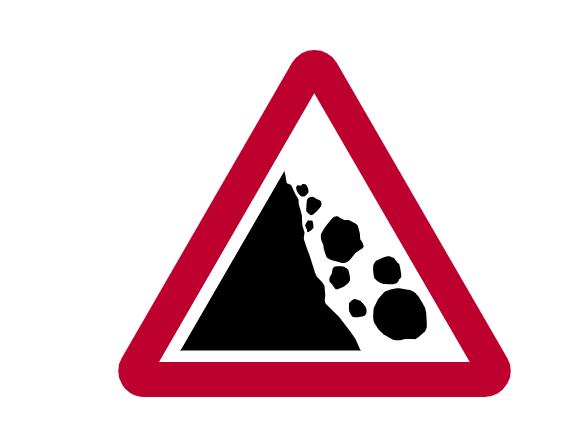
Risk of flooded road.
Risk of falling rocks.
Risk of landslides.
This sign warns of falling rocks aheaSlow down, stay alert, and watch for rocks on the road, especially in hilly or mountainous areas.
When should you overtake another vehicle?
Whenever you are in a hurry.
When the road is busy.
Without checking mirrors.
Only when it is safe and legal.
Only overtake when it is safe and legal. Check your mirrors, make sure the road is clear, and do not overtake if it could put anyone in danger.
What should you avoid when joining a motorway?
Using the left-hand lane.
Adjusting to traffic speed.
Checking your mirrors.
Crossing solid white lines.
Do not cross solid white lines when joining a motorway. Stay within your lane until it is safe and legal to merge with the motorway traffic.
This sign means:
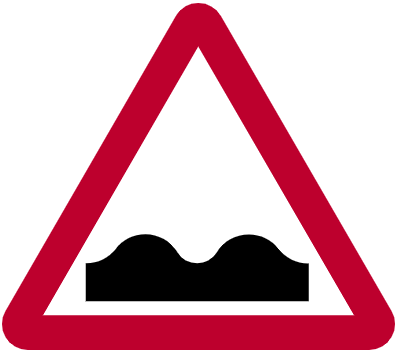
Slippery road.
Uneven road.
Rough surface.
This sign warns that the road surface is uneven aheaSlow down, keep a firm grip on the steering wheel, and be prepared for a bumpy ride.
Amber flashing lights mean you should:
Turn around.
Be ready for a hazard ahead.
Speed up to pass quickly.
Change lanes immediately.
Amber flashing lights warn of a hazard aheaSlow down, stay alert, and be prepared to stop or take action if necessary.
This sign means:
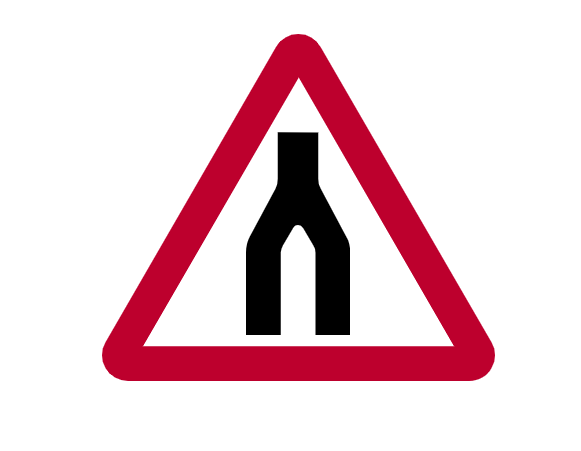
End of dual carriageway.
Start of dual carriageway.
Crossroads.
This sign warns that the dual carriageway is ending. Be prepared for traffic from the opposite direction and adjust your speed if needed.
If you have to stop on the roadside, what should you not do?
Park facing against the traffic flow.
Stop as close as you can to the side.
Do not stop too close to a vehicle displaying a Blue Badge.
You MUST switch off the engine, headlights and fog lights.
Do not park facing against the traffic flow. Always stop in the same direction as the traffiThis makes it safer when you stop and when you move off again.
Which of these is NOT allowed on a motorway unless directed by a police or traffic officer?
Use the left-hand lane.
Follow traffic signs.
Drive at a safe speed.
Reverse along the motorway.
You must never reverse on a motorway unless directed by a police officer or traffic officer. If you miss your exit, continue to the next junction and leave the motorway there.
When is the hard shoulder sometimes used as an extra lane?
Only at night.
During periods of congestion.
Only in good weather.
Whenever the motorway is quiet.
The hard shoulder may be opened as an extra lane during heavy traffiOnly use it when road signs show it is open. Otherwise, do not drive on the hard shoulder.
This sign means:
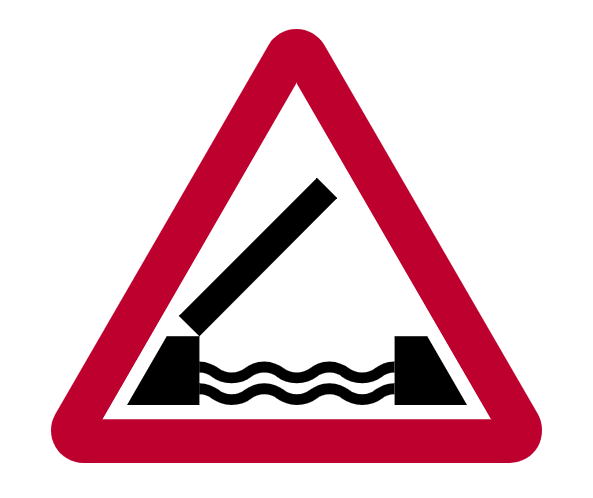
Hump bridge.
Railway crossing.
Swing bridge.
This sign warns that there is a swing bridge aheaBe prepared to stop if the bridge opens to let boats pass, and obey any traffic signals or barriers.
When may you use the hard shoulder if there is a red 'X' or a blank sign above it?
Whenever traffic is slow.
Only in an emergency.
To overtake other vehicles.
At any time.
If there is a red 'X' or no sign above the hard shoulder, you must not use it except in an emergency. Otherwise, stay in the normal traffic lanes.
This sign means:
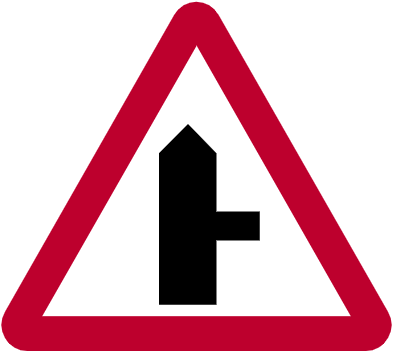
Side road.
Junction on a bend.
T-junction.
This sign warns that there is a side road joining the main road aheaSlow down, watch for vehicles entering or crossing, and be prepared to react.
When should you enter a lane that leads off the motorway?
Only if you want to go that way.
Whenever the lane is empty.
To overtake slower traffic.
To avoid other vehicles.
Only enter a lane that leaves the motorway if you intend to take that exit. Stay in the correct lane and follow the road signs to avoid sudden lane changes.
Which of these is a place of relative safety?
The fast lane.
A roundabout.
The central reservation.
A lay-by.
A lay-by is a safer place to stop than the roadside. It keeps your vehicle away from moving traffic and reduces the risk of an accident.
This sign means:
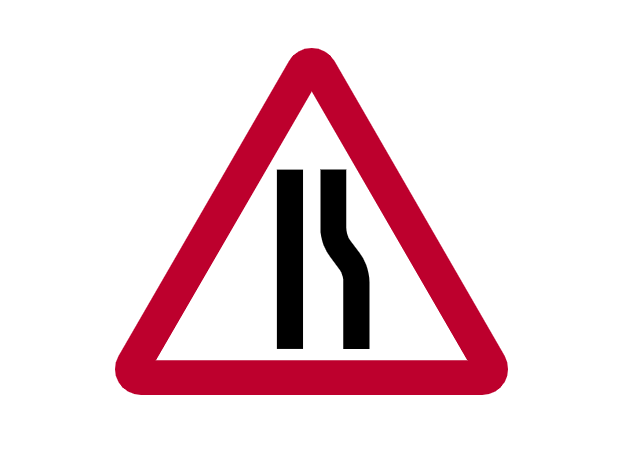
Road narrows on left.
Road narrows on right.
Dual carriageway.
This sign warns that the road becomes narrower on the right. Slow down, keep to your lane, and be aware of less space on the right side of the road.
On a motorway, you should normally overtake:
On the right.
On the left.
On either side.
Using the hard shoulder.
On a motorway, you should normally overtake on the right. After overtaking, return to the left-hand lane when it is safe to do so.
What is the safest way to drive on a motorway?
Only check mirrors before leaving the motorway.
Keep changing lanes often.
Look well ahead and use mirrors early.
Focus only on the vehicle in front.
Looking well ahead helps you spot hazards early, and using your mirrors regularly keeps you aware of traffic around you. This gives you more time to react safely.
You MUST NOT stop or park on
A pedestrian crossing.
A clearway.
A cycle track.
All of these.
You must not stop or park on a pedestrian crossing, a clearway, or a cycle track. These areas must be kept clear for safety and to allow traffic, cyclists, and pedestrians to move freely.
What does a red 'X' above the hard shoulder mean?
Use the hard shoulder.
Overtake on the left.
Stop immediately.
Do not use the hard shoulder.
A red 'X' above the hard shoulder means it is closed to traffiDo not drive in the hard shoulder unless directed by the police, a traffic officer, or a road sign.
This sign means:
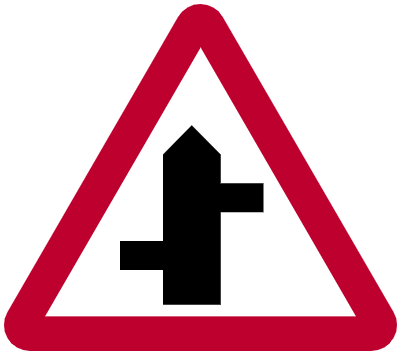
Staggered junction.
Box junction.
Pedestrian junction.
This sign warns of a staggered junction aheaSlow down, watch for traffic joining or crossing the road, and be prepared to give way if needed.
Very impressive test and glad to I answered some questions correctly
Very impressive test and glad to I answered some questions correctly . Looking forward to do more