Rules for cyclists, including an overview, road junctions, roundabouts and crossing the road.
Overview (rules 59 to 72)
Rule 59
Clothing. You should avoid clothes that may get tangled in the chain, or in a wheel or may obscure your lights when you are cycling.
Light-coloured or fluorescent clothing can help other road users to see you in daylight and poor light, while reflective clothing and/or accessories (belt, arm or ankle bands) can increase your visibility in the dark.
You should wear a cycle helmet that conforms to current regulations, is the correct size and securely fastened. Evidence suggests that a correctly fitted helmet will reduce your risk of sustaining a head injury in certain circumstances.
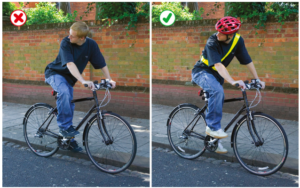
Rule 60
At night your cycle MUST have white front and red rear lights lit. It MUST also be fitted with a red rear reflector (and amber pedal reflectors, if manufactured after 1/10/85). White front reflectors and spoke reflectors will also help you to be seen. Flashing lights are permitted but it is recommended that cyclists who are riding in areas without street lighting use a steady front lamp.
Rule 61
Cycle Routes and Other Facilities. Cycle lanes are marked by a white line (which may be broken) along the carriageway (see Rule 140). Use facilities such as cycle lanes and tracks, advanced stop lines and toucan crossings (see Rules 62 and 73) where they make your journey safer and easier. This will depend on your experience and skills and the situation at the time. While such facilities are provided for reasons of safety, cyclists may exercise their judgement and are not obliged to use them.
Rule 62
Cycle Tracks. These are routes for cyclists that are physically protected or located away from motor traffic, other than where they cross side roads (see Rule 206). Cycle tracks may run alongside footpaths or pavements and be separated by a feature such as a change of material, a verge, a kerb or a white line. You MUST keep to the side intended for cyclists as the pedestrian side remains a pavement or footpath.
Some cycle tracks shared with pedestrians will not be separated by such a feature. On such shared use routes, you should always take care when passing pedestrians, especially children, older or disabled people, and allow them plenty of room. Always be prepared to slow down and stop if necessary (see Rule H2).
Rule 63
Sharing space with pedestrians, horse riders and horse drawn vehicles. When riding in places where sharing with pedestrians, horse riders or horse drawn vehicles is permitted, take care when passing pedestrians and horse riders, especially children, older adults or disabled people. Slow down when necessary and let them know you are there; for example, by ringing your bell (it is recommended that a bell is fitted to your bike), or by calling out politely.
Remember that pedestrians may be deaf, blind or partially sighted and that this may not be obvious.
Do not pass pedestrians, horse riders or horse drawn vehicles closely or at high speed, particularly from behind. You should not pass a horse on their left. Remember that horses can be startled if passed without warning. Always be prepared to slow down and stop when necessary.