Revision Module: 14 of 14
Full Free Driving Theory Practice Test 14
Your final comprehensive practice check covering all general UK road rules and traffic signs.
Syllabus Covered
The Highway Code & Traffic Signs
Question Pool
25 Multiple-Choice Questions
Target Pass Mark
Aim for 86% or higher
📝 Test Instructions: Your final review block. Aiming for an 86% or higher here shows you are completely ready for the actual exam.
Start Theory Test 14
Real Exam Mode: Q&A with Explanations
What should you do before moving off from the side of the road?
Accelerate quickly.
Check mirrors and blind spots.
Sound your horn.
Turn on hazard lights.
Before moving off, check your mirrors and blind spots and make a final observation. Move only when it is safe.
What should you do if a vehicle in front stops before a pedestrian crossing?
Overtake it.
Drive around it.
Wait behind it.
Sound your horn.
The vehicle may have stopped for a pedestrian. Do not overtake because you may not see someone crossing.
What should you do when approaching a sharp bend?
Maintain your speed.
Speed up before the bend.
Slow down if necessary.
Drive on the centre line.
You should reduce your speed when the road layout or conditions create a hazard, such as a sharp bend.
What is the safest way to brake in normal conditions?
Brake as late as possible.
Brake early and gently.
Always brake sharply.
Use the handbrake first.
Braking early and lightly gives drivers behind more warning and helps you stop smoothly and safely.
What is the minimum gap you should normally leave behind another vehicle on high-speed roads?
One second.
Ten seconds.
Five seconds.
Two seconds.
You should allow at least a two-second gap in good conditions. Increase the gap when road conditions are poor.
What should you do when approaching a zebra crossing?
Be ready to stop.
Speed up.
Overtake other vehicles.
Flash your headlights.
Slow down and be prepared to stop for pedestrians. You must give way to pedestrians on the crossing.
What does this sign tell you?
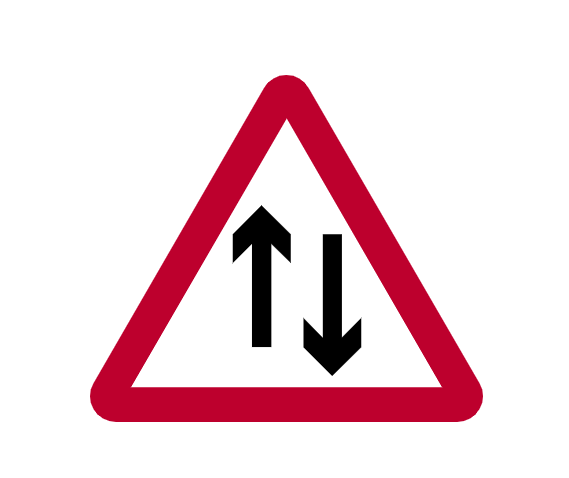
Two-way traffic ahead.
Dual carriageway begins.
Overtaking lane ahead.
No entry.
This warning sign tells you that traffic will be travelling in both directions on the road ahead.
When should you avoid overtaking?
When approaching a pedestrian crossing.
On a clear straight road.
When the road is empty.
When driving slowly.
Do not overtake near crossings because a vehicle may be stopping for a pedestrian you cannot see.
What should you do when passing a cyclist?
Pass as closely as possible.
Give plenty of space.
Use your horn continuously.
Force them to move left.
Cyclists are vulnerable road users. Give them plenty of room and pass only when it is safe.
What should you do if a pedestrian has started crossing the road you are turning into?
Turn in front of them.
Use your horn.
Give way and allow them to cross.
Drive around them.
Pedestrians crossing the road have priority. Wait and allow them to cross safely.
Which side of the road should you normally keep to when driving?
The right-hand side.
The centre.
The left-hand side.
Any side you prefer.
You should normally keep to the left unless you are overtaking, turning right or avoiding an obstruction.
What does this sign warn you about?
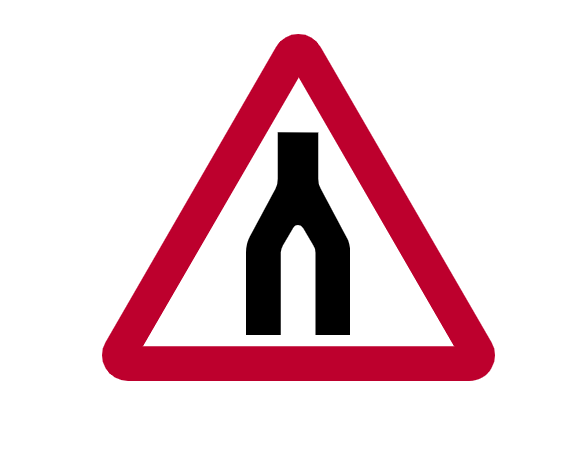
End of dual carriageway.
Start of dual carriageway.
Motorway ahead.
Two-way traffic at a crossroads.
This warning sign tells you that the central reservation is ending and the road ahead becomes two-way.
What should you do when the white lines in the centre of the road become longer and the gaps shorter?
Expect a hazard ahead.
Speed up.
Stop immediately.
Overtake quickly.
Longer white lines with shorter gaps warn you that there may be a hazard ahead. Take extra care.
What must you do before leaving a parked vehicle?
Leave the engine running.
Apply the parking brake.
Leave the headlights on.
Leave the door open.
You must apply the parking brake before leaving your vehicle to prevent it from moving unexpectedly.
What should you do before opening your vehicle door after parking?
Open it quickly.
Turn on hazard lights.
Sound the horn.
Check for cyclists and traffic.
Check all around before opening your door. This helps prevent collisions with cyclists, motorcyclists and pedestrians.
What should you do to your following distance on wet roads?
Keep the same gap.
Halve the gap.
Double the gap.
Drive closer.
Wet roads increase stopping distances, so you should allow at least twice the normal gap.
What must you do if the double white line nearest to you is solid?
Always overtake.
Stop your vehicle.
Drive on the centre line.
You must not cross or straddle it.
A solid double white line on your side means you must not cross or straddle it, except in limited permitted situations.
What is the meaning of this traffic sign?
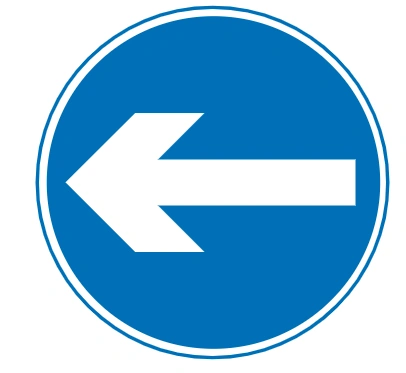
One-way street ends.
National speed limit applies.
Pass on either side.
Proceed in the direction shown.
This mandatory sign means you must travel in the direction indicated by the arrow.
Who should you give way to when turning into or out of a junction?
Only large vehicles.
No one.
Only cyclists.
Pedestrians crossing or waiting to cross.
When turning at a junction, you should give way to pedestrians who are crossing or waiting to cross the road.
What should you do if you need to make an emergency stop?
Brake immediately.
Close your eyes.
Turn off the engine.
Use the parking brake first.
In an emergency, brake immediately while trying to maintain control of your vehicle.
What should you do when approaching a junction?
Increase your speed.
Be prepared to stop.
Ignore other road users.
Always use your horn.
Approach junctions carefully and be prepared to stop or give way when necessary.
What does this road sign indicate?
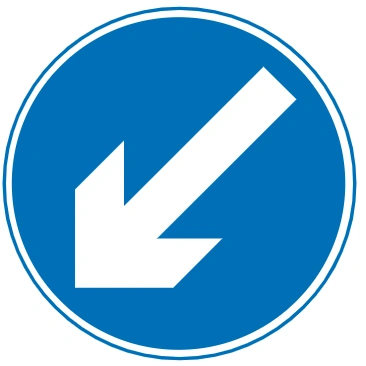
Turn left.
Keep left.
No left turn.
One-way street.
This mandatory sign tells you to pass to the left of an obstruction or traffic island.
What does a broken white line along the centre of the road mean?
You must not cross it.
It marks the centre of the road.
It marks a parking area.
It marks a bus lane.
A broken white line usually marks the centre of the road. You may cross it when it is safe and necessary.
What does this sign mean?
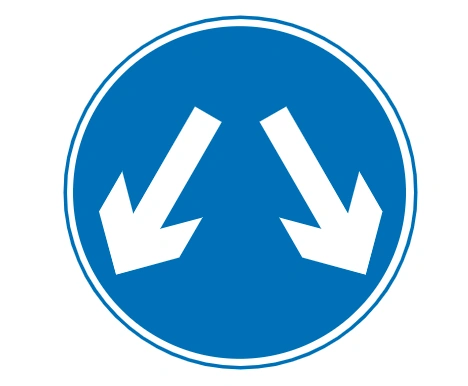
Road narrows.
Two-way traffic ahead.
Pass on either side.
End of dual carriageway.
This sign means traffic may pass on either side of the obstruction.
What should you do before overtaking another vehicle?
Move immediately.
Drive closer to the vehicle ahead.
Flash your hazard lights.
Check that the road ahead is clear.
Before overtaking, make sure the road is clear and that you have enough time and space to complete the manoeuvre safely.